Posted by: Aubrey Felix on February 25, 2026 at 8:20 am
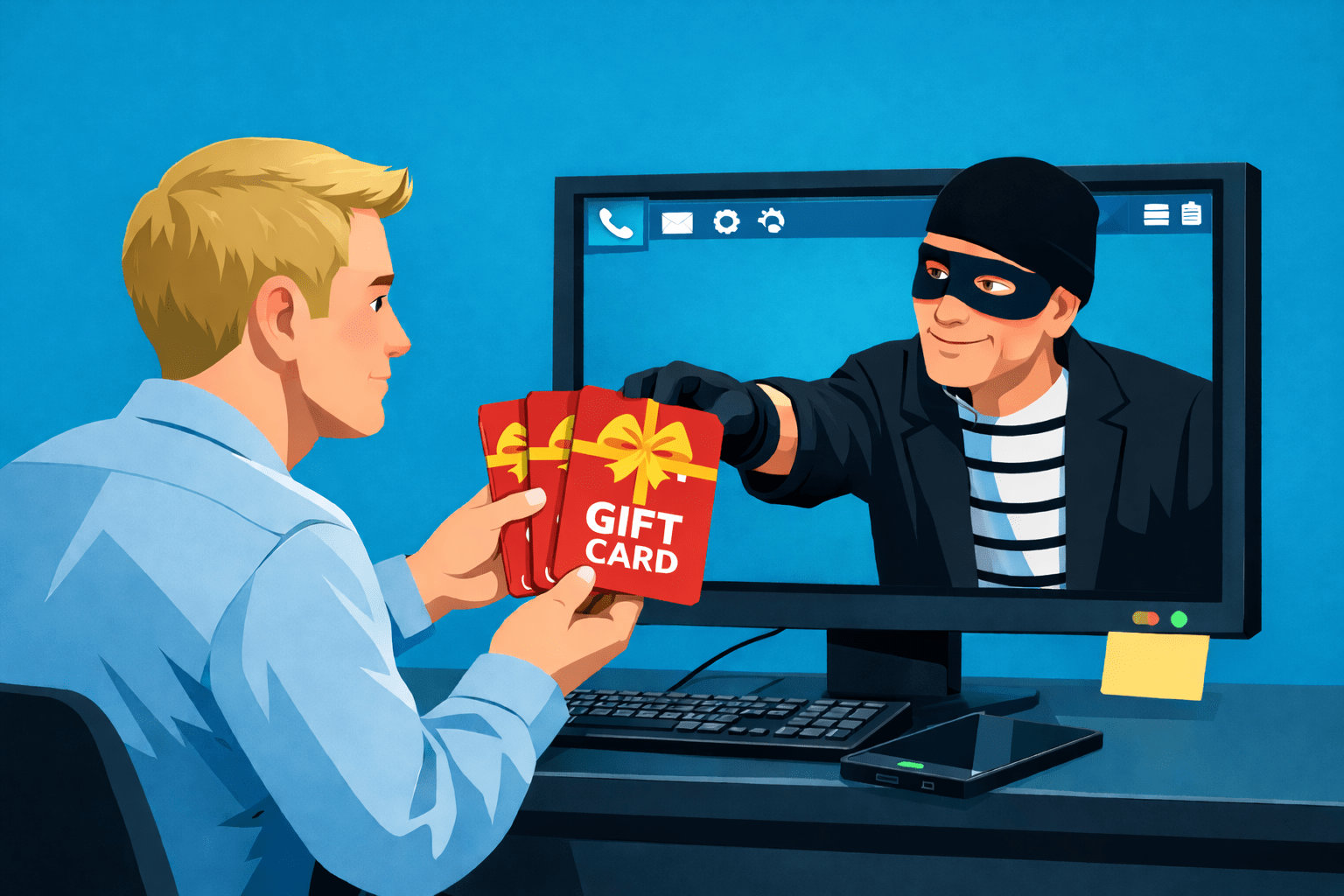
Photo created by Aubrey Felix
Refund scams have become one of the most persistent forms of fraud in recent years. We keep hearing about them, a fake charge, a “refund error,” a frantic call demanding gift cards. But many business owners still aren’t sure how they actually work. What makes these scams so effective isn’t advanced hacking. It’s timing, pressure, and a believable sequence of events that feels legitimate in the moment. You may not think you would fall for one, but we can see that many have. And they are generating some serious financial damage. According to the FBI’s 2024 Internet Crime Report, the category labeled “Tech Support” fraud accounted for nearly $1.5 billion in reported losses last year. (Refund scams are commonly tracked under “Tech Support” because they involve impersonated customer support representatives and remote access tactics.)
So how does a refund scam actually unfold in real time? And why is it so convincing when it happens?
To understand the risk, it helps to walk through a scenario:
Ryan was finishing up vendor invoices when an email notification caught his attention. It looked routine — a billing confirmation from his internet provider. But this one stated his service plan had been upgraded and that his new monthly charge would now be $500. But he hadn’t approved any upgrade.
The message instructed him to call a number immediately if the change looked incorrect. So he did.
On the other end was David, who introduced himself as customer support. He sounded calm and professional. He explained that billing errors happen and assured Ryan the charge could be corrected quickly. To process the refund, he said, he just needed temporary remote access to make the adjustment.
This is the pivot point.
After gaining access, David instructed Ryan to log into his online banking to confirm the correction. Moments later, Ryan’s screen showed what appeared to be a much larger deposit than expected. Instead of reversing a $500 charge, it looked as though thousands of dollars had been transferred into the account. David’s tone shifted. He claimed an accidental over-refund had occurred and insisted the excess funds needed to be returned immediately. He provided specific instructions: purchase gift cards to cover the difference and read the codes over the phone so the mistake could be corrected.
This is the moment where the scam becomes unmistakable if someone has been trained to recognize it. And it’s happening far more often than most business owners realize.
The Part Most People Don’t See
Refund scams follow a predictable rhythm. An unexpected charge triggers concern, the victim calls the number provided and the person on the phone moves quickly into problem-solving mode.
The Federal Trade Commission explains that tech support scammers contact people claiming there’s a problem with their device or account and attempt to persuade them to grant remote access. Their guidance is available here:
https://consumer.ftc.gov/articles/how-spot-avoid-and-report-tech-support-scams
That request for remote access is the pivot point. Once access is granted, the scammer typically walks the person into their online banking account “to verify the refund.” On the surface, that step feels logical. If a refund is being issued, you would check your account. But in documented cases, scammers use remote access tools along with built-in browser features to temporarily alter what appears on the screen. It’s important to note that the bank account balance itself isn’t changed, only the display in that browser session.
Suddenly, instead of seeing a $500 correction, the screen shows what appears to you as a $5,000 deposit. That’s when the tone shifts. The scammer claims an error was made and they insist the difference must be returned immediately. They might say they’ll lose their job or get in trouble. Whatever they say, remember that they are just trying to create urgency where there wasn’t any before.
We’ve seen this exact pressure tactic before. It’s designed to override your instinct to pause and replace it with urgency to “help” them.
The Gift Card Pattern
When there is a refund scam, they almost never ask you to pay through a normal banking correction. Instead, the victim is told to purchase gift cards and read the codes over the phone. That detail alone should stop the interaction. The FTC has been consistent on this point: legitimate companies do not demand payment through gift cards.
The financial damage tied to gift cards isn’t small. The scale of the damage tied specifically to gift cards is significant. The FTC’s Consumer Sentinel Network Data Book 2024 reports that fraud involving “Gift Cards or Reload Cards” resulted in $212 million in reported losses in 2024. Over $212 million linked to a single payment method tells us something important: gift cards are not an occasional tactic. They are central to how these scams succeed.
Scammers prefer them because once the code is shared, recovery becomes extremely difficult. There is no dispute process like there is with a traditional banking transaction. By the time the accounting team realizes something isn’t right, the gift card codes have already been redeemed.
What To Do If It Happens
If you get an email about an overcharge with a number to call, follow what the FTC recommends:
“Contact the company directly using a phone number you know is real. Do not use the number included in the message.”
If you suspect you’re in the middle of a refund scam, the first step is interruption. End the call right away and disconnect remote access. Contact the bank directly using the official number listed on its website. And notify your internal IT team immediately. They still start the needed action to help mitigate any damage that might have been done, or detect any vital security breaches.
Speed matters. The faster the interaction is broken, the better the chance of limiting damage.
Fraud can be reported to the FTC at:
https://reportfraud.ftc.gov
Or to the FBI’s Internet Crime Complaint Center at:
https://www.ic3.gov
Why Refund Scams Should Matter To You
Refund scams are structured, repeatable, and profitable and nearly $1.46 billion in reported losses in 2024 shows how often this works. There isn’t anything particularly complex about the tactic. It’s a billing question, a phone call, and a request to fix a mistake. It feels routine — right up until money is gone. If that call came into your office tomorrow afternoon, would your team recognize what was happening before they acted on it?
TAZ Networks can help your business with cybersecurity, and ongoing training for your staff. If you would like to find out more please contact us.