Posted by: Aubrey Felix on May 6, 2026 at 3:43 pm
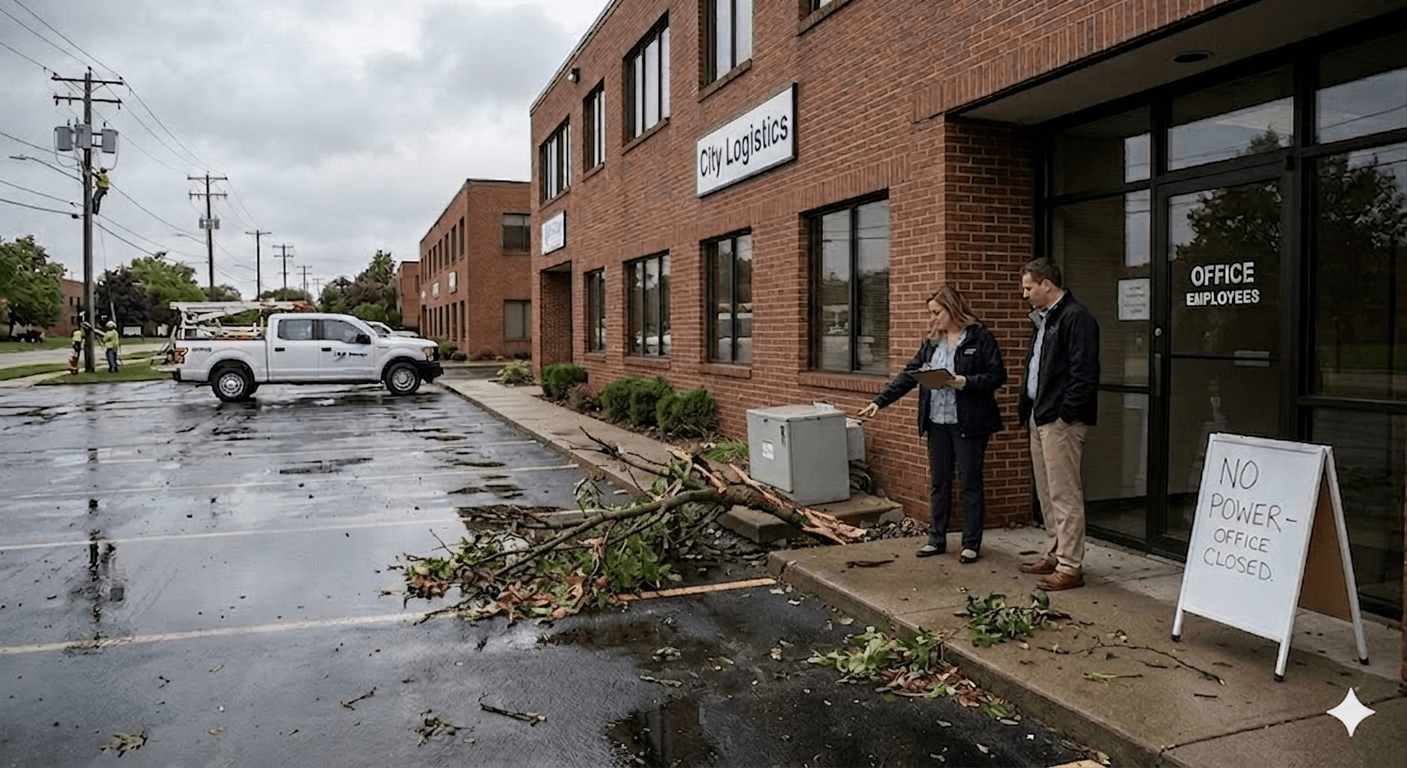
Storm Season Damage – Image Created by Gemini
Tornado’s Hit Michigan
This month was a sharp reminder that tornado season in Southeast Michigan is here. As storms moved through Southeast Michigan overnight on April 14 into April 15, tornado warnings lit up local communities, thousands lost power, and damage showed up close to home. For instance, Yost Ice Arena took roof and siding damage, and DTE reported 15,824 customers without power by 7 a.m. For homeowners, that kind of weather is stressful. For a business, it can quickly become an operations problem.
It’s not about the weather. It’s about whether your business can still run when the storm passes.
Because the real issue usually isn’t just the storm itself. It’s what happens next. Can your team get into the systems they need? Can orders move, customers get answers, and work keep going if the office loses power, internet, or access to critical files? That’s where severe weather becomes a real business risk.
The Invisible Damage After a Storm
When most people think about tornado damage, they picture the obvious: a collapsed roof, broken windows, or a building nobody can get into. But for many businesses, the bigger problem starts after the power comes back on.
And this is where the cost shows up. A server that shut down mid-process may not restart properly. A firewall can come back unstable after a surge. A switch can fail even though it looked fine the day before. From the parking lot, everything can look normal. Inside, the business is still down.
That’s why tornado-season planning isn’t just about the building. It’s also about the systems your business depends on every day. And if your systems go down, how much revenue are you prepared to lose? This is where a strong backup and disaster recovery strategy starts to matter. So how do you get started?
Five Questions to Ask Before the Next Storm Warning
You don’t have to be an IT expert to think through storm readiness. You just need to know what your business can’t afford to lose.
1. How long can we realistically be down?
If your systems were unavailable for four hours, what happens? What about a full day? Every business has a different limit, but it helps to know yours before you’re forced to find out.
2. Which systems need to come back first?
Not everything has the same priority. If power goes out, do you know what has to be restored first—phones, internet, scheduling, file access, or a key line-of-business application?
3. Who has access to passwords, systems, and recovery steps?
Too many businesses rely on one person who “just knows how it all works.” If that person isn’t available, can someone else still get to what the business needs?
4. Can the team still work if the office is unavailable?
If the building is closed or internet is unreliable, do employees have a backup plan? Can they securely access the files and applications they need from somewhere else?
5. How will we communicate if phones or internet go down?
If your main phone system is unavailable, does everyone know what to do next? A secondary communication plan can save a lot of confusion during an outage.
Backups Aren’t the Whole Plan
A lot of businesses assume they’re covered because they have backups. Backups matter, but they aren’t the same as a continuity plan.
If your data survives but it still takes a day or two to restore the systems your team needs, your business is still down. The goal isn’t just to recover data. It’s to reduce downtime and get the business running again in a realistic order. That’s the difference between IT recovery and business continuity. One is about fixing the technology. The other is about keeping the business running while that happens.
So start to think about things that would halt operations. It could be internet and phones, it might be file access, scheduling, or one line-of-business application on a server that you don’t even know how old it is. Once you know that, you can make smarter decisions about recovery, redundancy, and who on your team needs access when things go south.
Don’t Wait Until the Next Storm Hits
This month’s storms matter beyond the news cycle. These hit in our backyards, and that makes it clear this is not just about a warning or a close call.
For most businesses in Southeast Michigan, the most likely disruption isn’t a direct tornado strike. It’s a power outage, unstable systems, building-access issues, or equipment that doesn’t come back cleanly the next morning. This is where managed IT services and disaster recovery planning come into play. Tornado-season risk is not just about weather. It is about whether your infrastructure is stable, whether your recovery process is tested, and whether your business can keep moving when a storm exposes weak points you did not know were there.
If you’re not completely sure how your business would handle a day without power, internet, server access, or office access, now’s the time to review the weak spots.
TAZ Networks helps Michigan businesses build IT plans that work when severe weather hits. Contact us today to review your current setup.