Posted by: Aubrey Felix on May 21, 2026 at 7:44 am
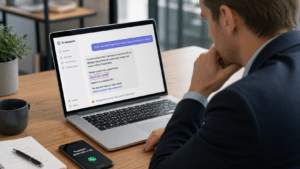
Is this an AI scam? Verify before clicking.
Let’s face it. AI tools are becoming part of everyday work, and businesses that ignore them may fall behind. They can summarize information, compare products, troubleshoot small issues, and answer quick questions. Used carefully, AI can save a lot of time. So why are we discussing AI scams?
What You Need To Know Before Trusting AI Search Results
Well, there’s one situation where you need to be more cautious: using AI to find customer service numbers, login pages, payment portals, refund instructions, or account support. Why is that? It sounds harmless. You have a problem, ask AI for help, and get a polished answer in seconds. But just because the answer looks polished, doesn’t always mean the information is safe.
With the rise in AI tools comes the rise of AI-related cybercrime. Just like AI can make our lives easier, it can make a scammer’s life easier as well. Scammers know people trust convenient answers. If they can plant fake information online, like a fake support phone number or a fake login page, there is a chance that information may appear in search results, forums, comments, review sites, or even AI-generated summaries. Then you may think you’re calling the real company, but instead you may be calling a scammer.
In cybersecurity terms, this is often described as AI poisoning or training data poisoning. In simple terms: Garbage in, garbage out. AI can repeat bad information if bad information makes its way into the sources it relies on. Which we know can happen easily on the internet.
How The Scam Works
Imagine you are trying to fix a vendor account issue. Maybe a software bill looks wrong, a social media account is locked, or a shipping portal is not showing the right information. You need help quickly, so you ask an AI tool:
“What is the customer service number for this company?”
The AI gives you an answer that looks professional. It may even include a phone number, a short explanation, and what appears to be a source. That polished answer can make the information feel safer than a random search result, but AI is better at organizing information than verifying intent. It may not know whether a source is official, current, or planted by someone with bad intentions. So you call. The person who answers sounds helpful and professional. They say they can fix the problem, but first they need to “verify the account.” They ask you for a username, email address, phone number, or company name. And that feels normal because real support teams often ask those basic questions too.
Then the scam begins.
From there, the scammer may ask for sensitive information, such as a password reset code, credit card number, or banking details. They may also send a fake login link or claim you need to pay for upgraded support before they can fix the issue. They might try rushing you to share a code, make a payment, or log in through a link they provided, stop and verify the request through the company’s official website.
The Password Reset Code Trap
One of the most dangerous versions of this scam involves a real verification code. Here is how it works: The scammer asks for your username, email address, or phone number. While they are talking to you, they use that information to trigger a real password reset request from the legitimate company.
A real code arrives by text or email. Then the scammer says something like: “Read me that code so I can verify your identity.” Or: “That code confirms the account so I can complete the fix.” What should you do at this point? The FTC gives very direct advice about this:
“Never give your verification code to someone else. It’s only for you to log into your account. Anyone who asks you for your account verification code is a scammer… Your account password and a verification code work together, like the lock on your doorknob and a deadbolt lock. If you unlock the doorknob but not the deadbolt, you can’t get in. Likewise, if you know the account password but not the verification code, you can’t get in. The same goes for scammers trying to get into your account. To break into your account, scammers need both keys. That’s why they try to trick you into sharing your verification code.”
So to be clear, AI does not create the scam. But it can make the scam feel more legitimate.
Red Flags To Watch For
Be careful when an AI response points you toward urgent actions. That includes instructions to call immediately, log in through a provided link, download a file, verify your account, share a code, or make a payment.
Also be cautious when the source does not clearly come from the company’s official website. A customer service number from a forum, review site, social media post, random blog, or unfamiliar domain should not be trusted.
Another warning sign is a citation that doesn’t actually support the answer. Sometimes a link may be broken, lead to an inactive page, or point to a source that never confirms the phone number or instruction in the AI response.
When AI Is Helpful, And When To Verify
AI can be useful for low-risk research. It can help explain terms, summarize general concepts, compare features, brainstorm ideas, or give background information.
For example, it is reasonable to ask AI:
- “What is multi-factor authentication?”
- “What is the difference between cloud backup and local backup?”
- “What should I consider when comparing business phone systems?”
But you should not rely on AI as the final source for:
- Customer service phone numbers
- Login pages
- Password reset instructions
- Payment links
- Refund requests
- Banking support
- Security alerts
- Vendor account issues
- One-time passcodes
For those situations, go directly to the official source. Open a new browser tab and type the company’s website yourself. Use a saved bookmark. Check the official app. Look at a previous invoice, contract, or known vendor portal. A good rule of thumb is that if the issue involves money, access, or security, slow down and verify before taking action.
The Simple Truth To Remember
AI can be a starting point. It should not be the final step when accounts, payments, passwords, or business systems are involved. And AI is not the attacker, it is a tool that can be misused. The real defense is still human judgment.
At TAZ Networks, we help small and medium-sized businesses build practical cybersecurity habits before small mistakes become expensive problems. As AI becomes part of daily work, AI scams will become more common. And cybersecurity awareness needs to include more than suspicious emails and bad links. It also needs to include the information employees trust from AI tools.
If your team needs help strengthening security awareness, reviewing account protections, or improving day-to-day IT safeguards, contact TAZ Networks today.